Olympic warriors
The incredible stories of three Olympic heroes who fought for their country.

This article formed the script for a YouTube video by Redcoat History. Watch here.
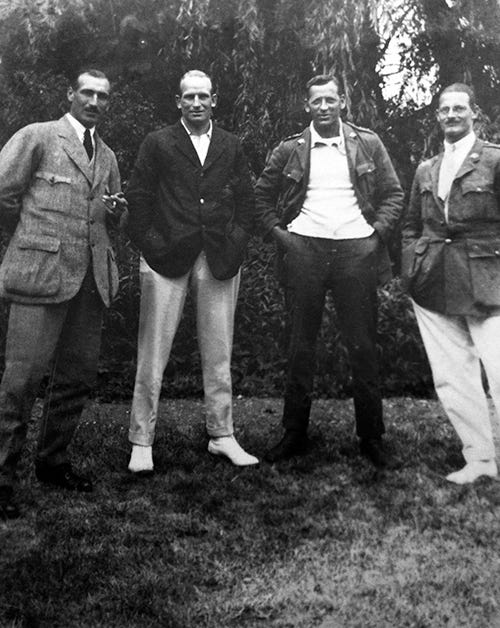
Wyndham Halswelle, a stiff upper lip British officer. Lewis Clive, a champaign socialist. And Sydney Middleton, a man not afraid to break someone’s nose.
These three men are connected in a very special way, they each represented their country at the Olympic Games — they also fought for their country when duty called.
Wyndham Halswelle
Wyndham Halswelle has the unenviable mantle of being the only Olympic gold medalist to win in a walkover — he does however, have the enviable title of being Scotland’s first track and field Olympic champion.
Halswelle enjoyed an upbringing of comfort, being educated at Charterhouse School where he showed signs of athletic prowess. After Sandhurst he was commissioned as a Second Lieutenant in the Highland Light Infantry in 1901, alongside whom he quickly found himself in South Africa and riding with the mounted infantry.
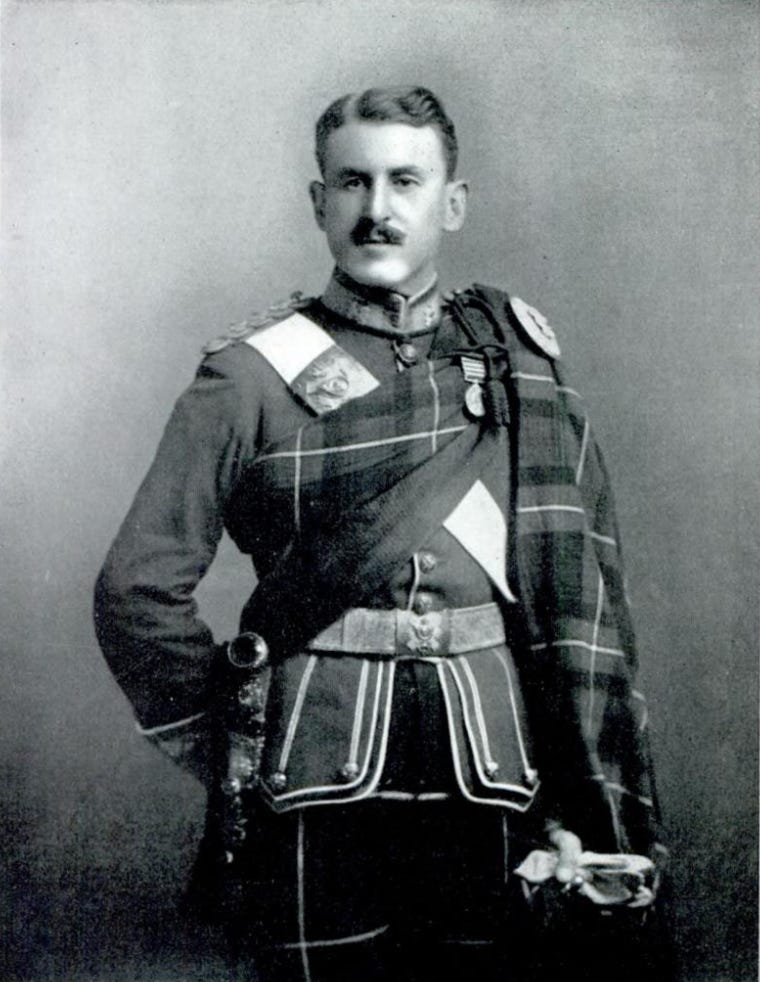
For a brief period, the army took precedence over his athletics, however following some encouragement from his comrades this changed.
In the lead up to the 1906 Athens games he wiped the floor with his opponents in local competitions. In Athens he medalled twice, missing out on a gold however. On returning from Athens, at the Scottish Championships, he won the 100, 220, 440, and 880 yard races all in a single afternoon, and against former Olympic champions.
Halswelle remained humble, and was typical of the early 20th century British officer. When a sports reporter asked him about his triumphs he refused to entertain him, and said that it was not the done thing for a British officer to talk on such things.
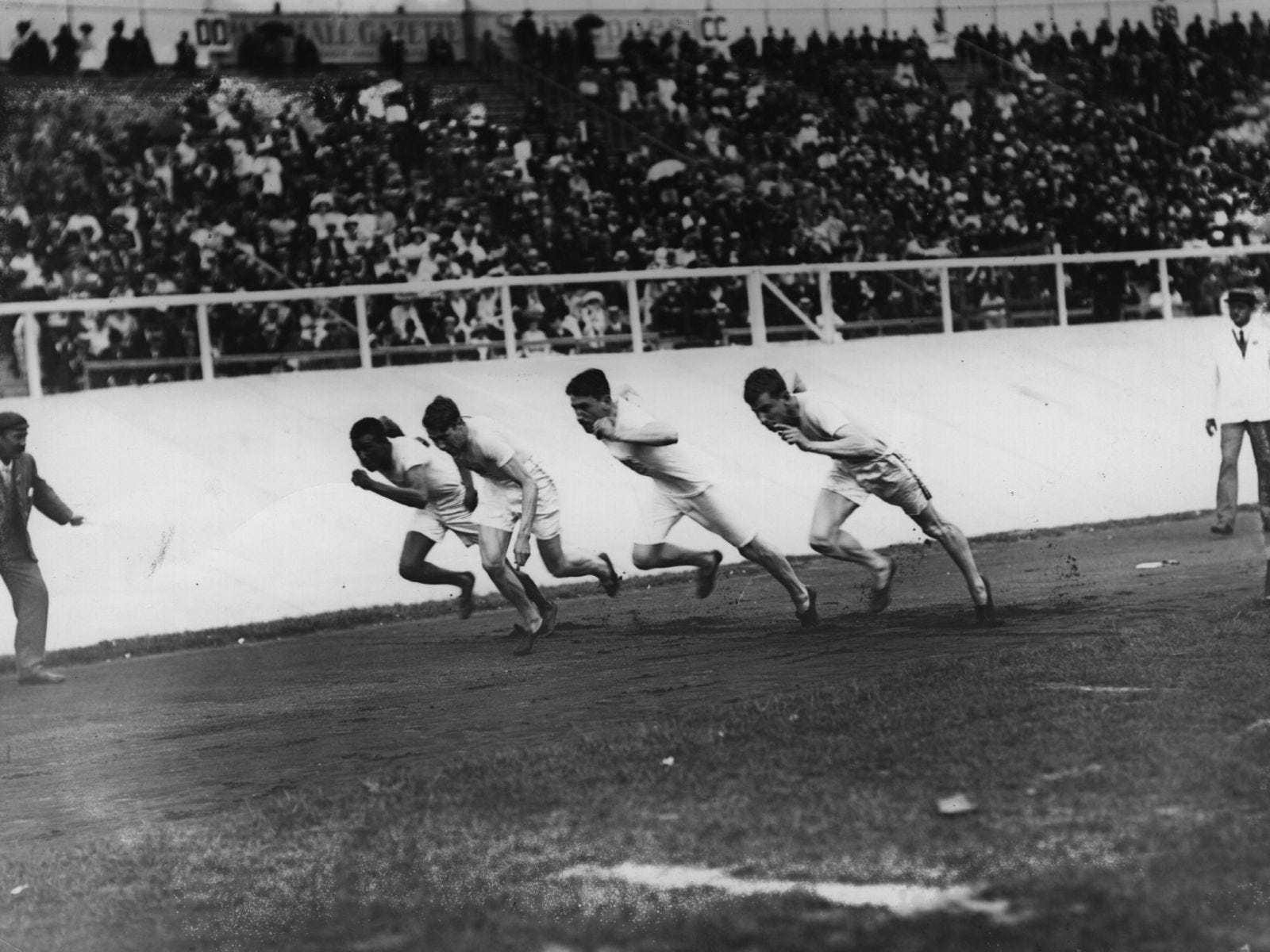
Despite his good-natured character, Halswelle remains most well known for the 1908 Olympic controversy that he was the victim of. He had set the Olympic record for the 400m sprint, coming in at 48.4 seconds, and faced up against three American runners. Back in these days, there were no lanes for each runner, and it was a bit of a free for all at times. One of the American runners purposely ran wide and raised his arm to prevent Halswelle from passing him, “He bored me across two-thirds of the track, entirely stopping me running,” said Halswelle, who crossed the finish line at a jog.
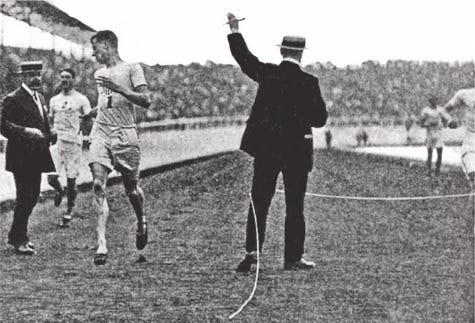
The race was declared null and void, and a re-run ordered, without the offending American. His two compatriots refused to take part in the race, which meant that there was now one runner left who could compete. Halswelle didn’t like it, but he ran anyway, claiming the only ever walkover gold medal in the Olympics.
His brother officers were of the view that Halswelle was being taken advantage of, and he retired from athletics at the end of 1908, and focused exclusively on his army career. Promoted to Captain in 1911, he gained command of a company which he took to war a few years later.
Halswelle proved to be a very popular officer among the men he commanded, one man described him as “the best officer in the Battalion,” and added that “the men would follow him anywhere. And it was always a case of following.”
After a few scrapes, Halswelle’s battalion found themselves in the trenches at Neuve Chapelle. It was here that Halswelle met his demise.
“I never saw him cheerier than before Neuve Chapelle,” wrote a comrade. “We knew we were in for a big thing, and when the time came for us to advance, after our artillery had finished with the Germans, we followed him eagerly forward. The air was thick with shrapnel and machine gun fire, and we had not gone very far before Captain Halswelle was hit about the forehead. ‘It’s not much,’ he told one of the Lieutenants. ‘It’s just a scratch.’ But he was bleeding freely, and he was advised to get back and have the wound dressed. He ran back to the first-aid post, apparently hoping to get a bandage on his head and return to the fight. But the doctor kept him. He seemed to have been hit by a piece of shrapnel, but it had only grazed his head. He did not reappear that day or the next, but he was able to lead us back to the trenches a week later, after our rest. It was on the morning of the second day back in the trenches that he was killed. He and Lieutenant Henderson were coming along the trench, giving directions here and there. The trench was not very deep, and one could not walk upright with safety at certain parts. Ten yards away from where I lay the Captain was struck. His head had shown above the trench in walking, and a sniper got him about the temple. He dropped unconscious immediately. Stretcher-bearers were signalled for, and he was carried back to hospital, but he died half an hour afterwards.”
79 of the Highland Light Infantry soldiers died, for a gain of 15 yards.
Lewis Clive
Described by some as the Red Blue and a champaign socialist, Lewis Clive was a man who stuck to his beliefs, and wasn’t afraid to die for them.
He came from a very strong military family, indeed he was a descendant of Clive of India. His father was killed in France too, he was a Lieutenant Colonel in the Grenadier Guards.
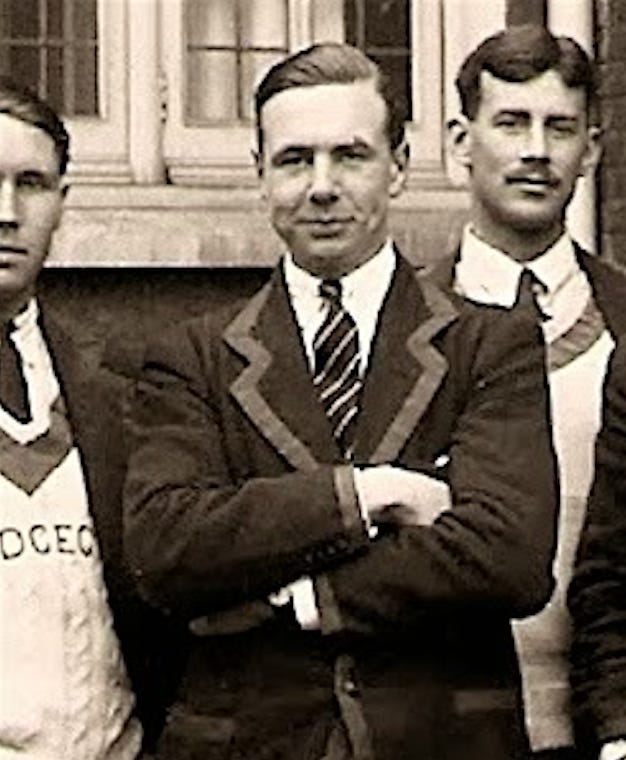
Lewis was a product of Oxford University. He had been captain of the boats at Eton, and continued this form while at Oxford, becoming the Blue (the highest individual honour given to athletes at Oxford). He was eventually selected to row for Team GB at the 1932 Olympics in Los Angeles where he and his rowing mate comfortably saw off all challengers, with second place coming in 2 seconds later, and 3rd placed Poland coming in 8 seconds later.
While he was off in LA enjoying the sun and adoration of an Olympic gold medalist, Lewis was commissioned into the reserve of the Grenadier Guards as Second Lieutenant. After 5 years of peacetime reserve soldiering he resigned his commission and sought adventure.
Some context is now needed. While he was at Oxford he was a member of the Bullingdon club — the same Bullingdon club that Boris Johnson was later a member of — but it would also seem that he flirted with left wing ideas, a newspaper obituary recorded that after Oxford his “political ideas were uncertain.” Most importantly, he eventually became a member of the Labour Party, and also the Fabian Society. While a member of the Fabians, he wrote quite a progressive book for the time, which stated that if European democracy were to survive it would require democratically organised armies — specifically he called for more men to be commissioned from the ranks. Lewis Clive, you would have loved Sharpe.
There are even whisperings that Clive was a secret member of the Communist Party of Great Britain.
The great adventure that the Red Blue sought was to be found in Spain. As soon as he resigned his British Army commission he joined the British Battalion of the 15th International Brigade and went off to fight against the fascists in Spain.
He had a few moments of heroics that were recorded during his time in Spain, including swimming across the Ebro river with its incredibly strong currents to save some equipment, as his comrades were swept away.
There is also a tale of “remarkable escape” he made “after an overwhelming advance of Italian tanks, he found himself cut off behind enemy lines, but succeeded in crawling back to his own lines after 10 days of great privation.”
Clive eventually became a company commander, although he was soon to meet his maker. During the Battle of the Ebro his battalion commenced their attack by rowing across the Ebro river, his men met with heavy resistance from a position on Hill 481 which they attacked a handful of times.
There is an idle barrack-room rumour that he was shot by drunken friendly fire, though this is discounted by eye witness accounts. One of which is as follows:
"Lewis Clive re-appeared and asked about the activity in the fascist lines. It was a hot, sunny day and, as usual, my shirtsleeves were rolled up. At that moment I felt splashes on my left forearm, and glancing down, was astonished to see they were splashes of blood. Turning, I saw Lewis reel and fall. Someone below said ‘What a ghastly sight.’ I slid down from my firing position and saw that the top of his head was severed completely and, as he lay there, the brain was spilling from its case. It was indeed a ghastly sight.”
His Times newspaper obituary recorded: “Lewis Clive’s many friends, whatever their political views, will not forget his inspiring courage, and will find some consolation in the knowledge that he died gallantly at the head of his company on the Ebro front in what he was convinced was a critical struggle to save democracy for Spain and ultimately for Europe.”
Sydney Middleton
Probably the most versatile athlete on this list, Sydney Middleton competed in two different Olympics, in two starkly different sports. He also won the DSO with the Australian Imperial Force in the First World War.
Middleton’s first sport was Rugby, and he rose through the grades until he eventually found himself on the first Australian Rugby side to tour the northern hemisphere. This was the same tour where the Australian rugby team gained the nickname “The Wallabies.”
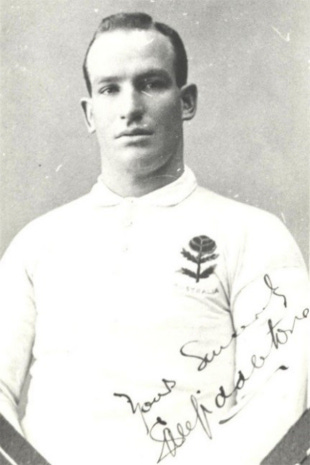
The Wallabies played a whole bunch of matches against various English sides on the tour, winning most of their games.
It was quite an eventful time. During one of the tour matches against Oxford, one of the opposition players called Middleton “a convict,” which went down very well of course. Middleton then re-arranged the poor Oxford player’s nose with a quick uppercut. A local rag described the incident as a byproduct of the “unfair and unsportsmanlike methods of the colonials.” Some things never change.
The highlight of the trip however was the 1908 London Olympics, where Middleton and the Wallabies won gold against quite literally the only other team competing, Cornwall… who were representing Great Britain.
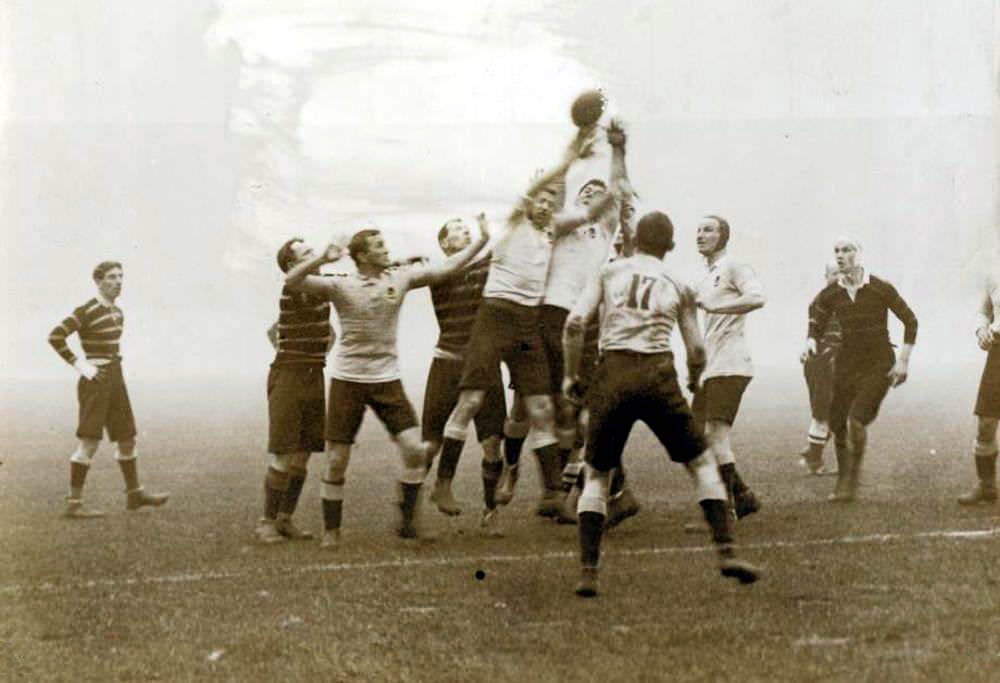
After the Olympics, Middleton debuted in tests and tried his hand at captaining the side, a role he filled on the national level three times. However, his rugby career was to be short-lived, as he retired to focus on another sport — rowing.
While he was rising through the rowing ranks, Syd remained a member of his local rowing club, and often appeared on the New South Wales team. Again, the highlight of his rowing career was the 1912 Stockholm Olympics, where he was part of the Australian men’s eight. Unfortunately, there were more than 1 opposing team, and Australia were beaten in the second round by a British crew. Middleton remains the only person to ever compete in both events at the Olympics.
Middleton joined the Australian Imperial Force in May 1915 and was given a commission as 2nd Lieutenant in the 19th Battalion. In quick time Middleton found himself aboard a troopship destined for Egypt, and latterly ANZAC Cove. Two days after arriving at Gallipoli the 19th Battalion took part in an attack on Hill 60, which was to be the last major offensive of the Gallipoli campaign.
Following the Gallipoli debacle, the 19th Battalion and the now Captain Middleton embarked for France, where they took part in battles such as Pozieres, Bullecourt, and Flers, which was described as “the worst conditions ever encountered by the AIF.” By January 1917 he had been promoted to Major and at times commanded the battalion in battle, which was noted in his DSO citation. The citation added that the “battalion owes much of its success to the splendid example set by this very fine type of officer.”
Another Australian rugby player of the time wrote of Syd during the action at Pozieres:
“Oh, what a wreck he is, he must be looking ten years older since I saw him last. Middleton was practically buried five times in one day, his stars were shot away from his shoulder on one side, the heel of his boot was dinted and his foot wrenched, a piece of shell penetrated his side and made quite a gash. And worst of all for a while, a huge lump of dirt that knocked him down and shattered his mind for a few moments. He thought his time had come to die. Day and night there was no relief, the carnage and the toll was more than man could ever realise. Dante and his inferno is a huge joke. It is the real hell.”
It was after the war that Middleton took on one of his most important roles. He was ordered to take on the job of organising secretary for the AIF Sports Control Board, which had the quite simple and straightforward directive of keeping “a couple of hundred thousand home-hungry soldiers contented.”
Middleton took to this with great aplomb, and for his efforts he was awarded the OBE.