
X Company, Scots Guards
A brief outline of a unique Scots Guards unit and two of the men who served in it.

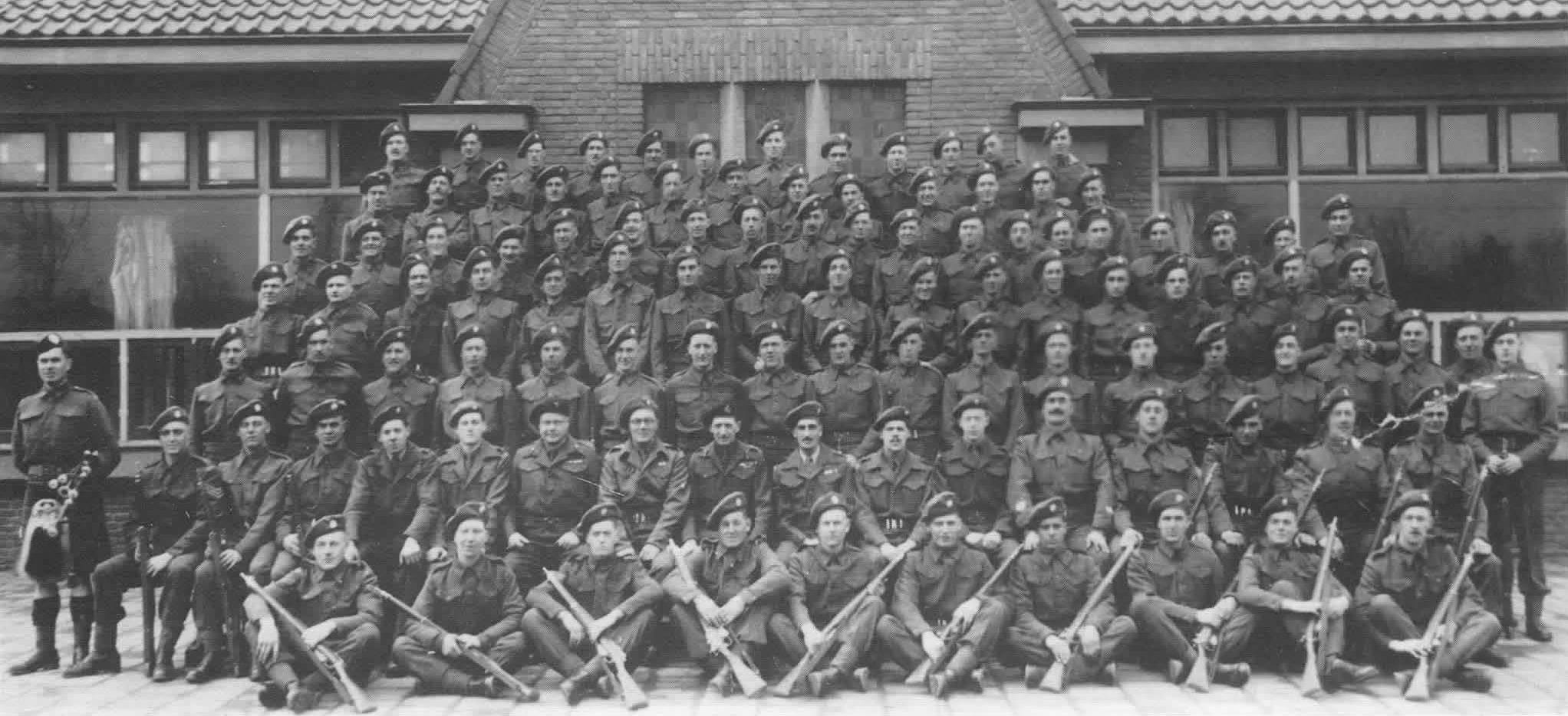
The first Scots Guards unit to enter the fray in North-West Europe (NWE) was one which many are not entirely aware of — infact, a veteran of this unit wrote that when he informed fellow Scots Guardsmen that he served in “‘X’ Company”, the enquirer usually looked at him with a puzzled expression.
‘X’ Company was formed alongside the 4th Battalion Scots Guards in October 1941, however this battalion was to be short-lived, and was disbanded 2 years later in October 1943. However, two of the 4SG companies (Right Flank and ‘X’ Company) were kept at strength and went on to fight in Italy and North-West Europe respectively.
After the disbandment of 4SG, ‘X’ Company (then under the command of Captain Richard Derek Cardiff) were attached to the 3rd Battalion Irish Guards (3IG) commanded by Lieutenant Colonel John Ormsby Evelyn Vandeleur, who was depicted by Michael Caine in the film ‘A Bridge too Far.’ It was originally intended this arrangement would continue until the required number of Irish Guardsmen were sufficiently trained up — however, this only eventuated in August 1944.
Captain Cardiff was to leave ‘X’ Company in March 1944 for a new post, and a new commander was required. The unique task would fall to one Major Patrick ‘Feathers’ Steuart Fothringham who was then second-in-command of 2SG in Italy. Major General Claude Dunbar considered ‘Feathers’ ‘a unique figure’ and also wrote that ‘his Company regarded him as something superhuman.’
Major Steuart-Fothringham was supported by very able brother officers including Captain Edward James Hope MC who later commanded the Company following the evacuation of ‘Feathers.’
After a period of hard training and preparation, ‘X’ Company disembarked in France on 23 June 1944. They were to spend the next 268 days fighting through France, Belgium, Holland, and Germany. Under their attachment to 3IG they took part in battles such as ‘Operation Goodwood’ and the capture and defence of Maisoncelle. Moreover, it was during their time attached to the 1st Battalion Welsh Guards (1WG, beginning on the 23rd of August 1944) that ‘X’ Company experienced their toughest fight of the campaign in North West Europe — the battle of Hechtel, described by the then Lieutenant George Llewellyn as ‘a bloodbath’.
Disbanded and dispersed among the ranks of the refitted and rested 2nd Battalion Scots Guards (2SG) on 18 March 1945, ‘X’ Company ceased to exist as a unit. Throughout their existence they lost 28 men killed or died of wounds, 93 wounded in action, and a further 8 captured. The Company was also awarded 1 DSO, 4 MC’s, and 7 MM’s.
As a testament to ‘X’ Company’s remarkable service, at the 1959 Scottish Schoolboys Exhibition, the two dioramas displayed at the Scots Guards stand were Captain The Lord Lyell’s VC action at Djebel Bou, and ‘X’ Company’s action at Hechtel.
The following is a brief biography of two ‘X’ Company personalities.
Lieutenant The Lord Grimston of Westbury
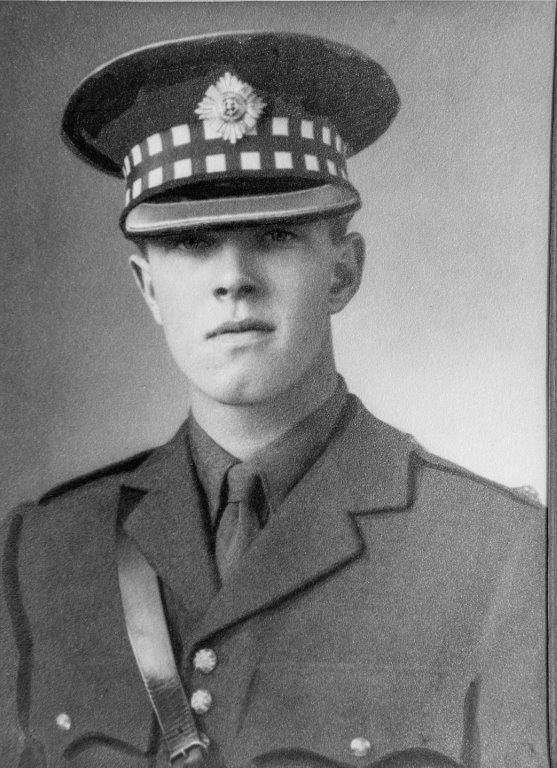
Robert Grimston was born on the 14th of June 1925, to parents Robert Villiers Grimston and Sybil Grimston. His father — a Conservative MP — was a veteran of World War One, who served with the 6th Howitzers Royal Garrison Artillery on the Macedonian Front and in the Palestine campaign.
Grimston was educated at Eton College between 1938 and 1943, and was a member of the Officer Training Corps. He was quite a popular boy according to Lord Hurd of Westwell, and became Captain of Mr. Kerry’s House. During this time he also worked in a Slough munitions factory by night. Wishing to serve in the Scots Guards, he was recommended for service in the Regiment during 1942, and interviewed by the Regimental Lieutenant Colonel in April of that year. However, it was decided with him still only being 16, he would remain at Eton for one more year. On the 9th of June 1943 he was accepted as a potential officer for service in the Regiment and ordered to report to the Guards Depot, Caterham, and subsequently 161 Officer Cadet Training Unit at Mons Barracks, Aldershot.
After initial training, Robert Grimston was granted an Emergency Commission in the Scots Guards as a Second Lieutenant and joined the Training Battalion Scots Guards at Pirbright on the 3rd of April 1944.
In early August 1944, Second Lieutenant Grimston received embarkation leave, as he had been earmarked to join the 1SG who were in Italy at the time. However, on his return, he found that his name had been struck off the list.
Quite an amusing situation occurred the following day, in that he was informed — much to his surprise — that he was to be a mortar officer. However, ‘after two hours’ work on the 3-inch mortars ‘I was suddenly switched to anti-tank guns, as it was really an anti-tank officer that was wanted!’
Five days later, our anti-tank officer was informed that he and thirty Scots Guardsmen were to embark to France for service with ‘X’ Company, and on the 21st of August the draft set off in infantry landing craft, sans escort; however, that was not to be the main problem as ‘by 10 p.m., many, including myself, were feeling ill, and the ship was tossing about like a cork’ he wrote. At 8 a.m. the next morning the boats sailed very close to Caen where a ‘terrific artillery bombardment was in progress.’
As ‘X’ Company were not in need of a Platoon Commander, Second Lieutenant Grimston spent approximately a month attached to 40 and 34 Reinforcement Holding Units (RHU) It was during this period that he had his ‘first “go” at the Huns.’ With a platoon of Coldstream Guardsmen, he (along the rest of his RHU) was tasked to clear a vast forest in which ‘bands of SS fanatics’ were operating out of. Due to the size of the forest and limited amount of men available, this expedition was not so successful.
On the 25th of September, the now War Substantive Lieutenant Grimston was posted to ‘X’ Company (to command 13 Platoon), who were at that stage guarding the area around Nijmegen bridge. With the Belgian winter setting in, the ‘season of great advances’ had come to an end, and ‘X’ Company was employed guarding the frontier in towns such as Veulen & Sittard, where they gained a reputation for aggressive patrol work. It was during this period that Lieutenant Grimston took out patrol near the village of Veulen, on the night of the 5th of November. With 16 men (armed with 3 Bren guns, a PIAT[1], and Mortar) the patrol’s objective was to dominate and hold a cross-tracks which had been known to be a hive of enemy activity. After making initial contact with three Germans, the patrol advanced a little bit further toward the objective where they found oblivious Germans digging new positions from which they could surround 4 Company’s positions. ‘What a glorious target this was’ he recorded in his diary — the patrol laid down steady fire onto the German positions for 2 minutes, leaving themselves only enough ammunition to cover the way out. On the retreat the patrol was fired upon by about 3 ‘Spandau’ machine guns. One man from the patrol was wounded while it was reported that 8 Germans were seen being taken back on stretchers.
Lieutenant Robert Grimston’s time in North West Europe was to come to an end on Christmas Day, as around this time an enemy shell landed very close to his trench, resulting in a severe concussion. Admitted to 128th Field Ambulance, he was evacuated back to England on 5 January 1945. After his time in hospital, he undertook ‘Staff Learner’ appointments while attached to HQ Northern Command. In 1947 he was posted to Regimental Headquarters in the appointment of Assistant Regimental Adjutant.
Just prior to leaving the Army, Lieutenant Grimston travelled to Canada, where he was to take up a position as Aide-de-Camp to his cousin, Field Marshal Alexander of Tunis, while he was serving as Governor General of Canada.
After leaving the army in 1947 he was employed in various positions ranging from Stockbroker, to Director, and Member of the House of Lords.
2693634 WOII (CSM) Alexander ‘Jock’ Law
One of the most experienced men of ‘X’ Company was Company Sergeant Major (CSM) Alexander Law. Major George Llewellyn MC wrote that he was a ‘very special man, who after over two years in the job, knew all about everyone and was able to mix strict discipline with compassion.’
Alexander Law was born in Cowdenbeath, Fife in 1911 to parents Alexander and Marion Law. Before his period of service he was employed as a temporary Postman.
Enlisting into the Scots Guards at Edinburgh in September 1930 for ‘3 and 9’ (3 years with the colours and 9 in the reserve), he was immediately posted to the 1SG (then just taking up their posting as Headquarter Battalion at Chelsea Barracks). He quickly attained his 3rd and 2nd class Certificates of Education (distinguishing himself in the latter) before passing the examination for promotion to Corporal in December 1931 — however he wasn’t to be promoted to Corporal until 1934, holding the rank of Lance Corporal in the meantime. He also completed his 1st class Certificate of Education in 1932, and the examination for promotion to Sergeant in December 1934.
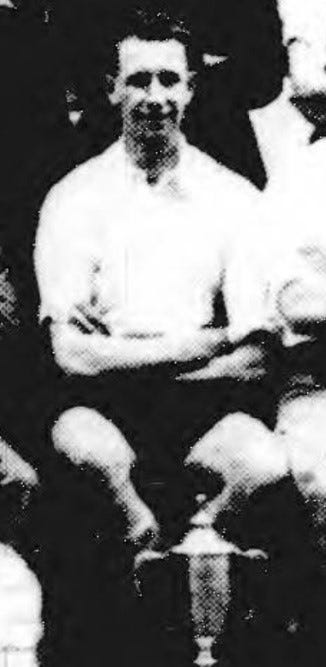
During this period of home service, Law made a reputation for himself on the football pitch, playing Centre-Half for the 1SG’s First XI, which he led in the Household Brigade Senior League. He also played for the Household Brigade team when it was formed in 1934 — there are many accounts of his on-field heroics in the contemporary Household Brigade Magazines.
In November 1935 Lance Sergeant Law was to sail for Egypt with 1SG whose turn it was to deploy to the troubled region. During this time he trained on an unusual weapon for British forces, the 13.2mm Hotchkiss anti-tank gun. It is of interest to note that during this period in Egypt many important figures in the ‘X’ Company story were present — Lieutenant Patrick Steuart-Fothringham (Garrison Adjutant and Quartermaster, Cairo Brigade area, later Officer Commanding ‘X’ Company) Captain George Johnson (later General Officer Commanding 32nd Guards Brigade) and Major Alan Adair (Quartermaster, 3rd Battalion Grenadier Guards, later GOC Guards Armoured Division) along with a handful of future ‘X’ Company OR’s.
Returning to the UK in December 1936, he swapped khaki for civilian dress and transferred to the Army Reserve in May 1937 with ‘exemplary’ conduct.
During this period, Alexander Law served as a Constable with the Newmarket and Bury St. Edmunds Police Force — he also played on the West Suffolk Police team, being known as a prolific goal scorer. In September 1939 he married Ada Petch at Fornham St. Martin Parish Church.
However, the period of peace was to come to an abrupt end, and he was mobilised at Pirbright Camp on the 1st of December 1939. In early 1940, he was posted to Headquarters of the 24th Guards Brigade and promoted Colour Sergeant. With this unit he was to take part in the ill-fated campaign in Norway between April and June 1940.
Upon return from Norway, Colour Sergeant Law remained with HQ 24th Guards Brigade for a while, before reverting to Sergeant at his own request and being re-posted to the Training Battalion, Scots Guards. Eventually, he was promoted to Company Quartermaster Sergeant in the Holding Battalion, and five months later to warrant officer class two (WOII) and appointed CSM in September 1942. In November that same year, CSM Law was posted to ‘X’ Company (then still part of 4SG), where he took over the role of CSM from John E. Morrison who was later killed in Italy.
CSM Law embarked to NWE with ‘X’ Company in July 1944, where he took part in the Normandy campaign, the Liberation of Brussels, and the battle of Hechtel in September 1944. For his service during this period he was awarded a Mention-in-Despatches.
On the 12th of September, CSM Law died of wounds sustained on the bloody third day of the battle of Hechtel. It was recorded in David Erskine’s history that his death was ‘a sad event; he had been Sergeant-Major since 1942, and could claim to be largely responsible for the excellent spirit and discipline of the men.
Brilliant Max, a great article and what fantastic group of soldiers.